Overview
Pruna AI Official Website
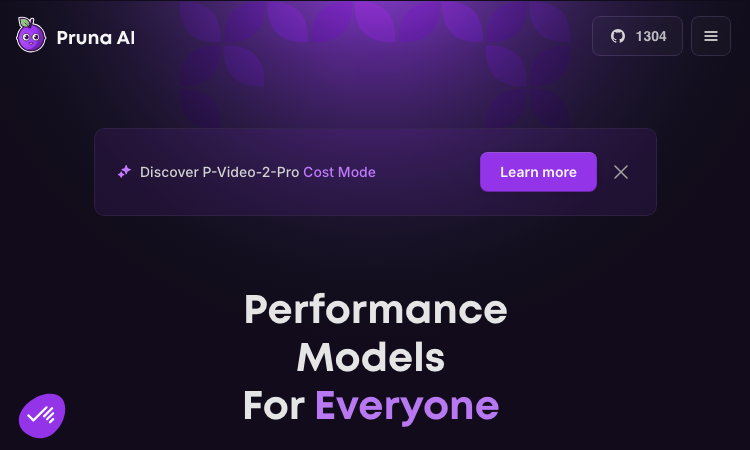
Pruna AI combines hosted performance models for image and video generation with an open-source Python toolkit for optimizing AI models. Developers can use its models through an API, deploy models in their own infrastructure, or use the Pruna package to apply model-compression and optimization methods.
- Official app: https://www.pruna.ai/
- Creator: Pruna AI; the company’s legal pages identify Pruna AI GmbH.
- Price: Hosted API models are usage-priced; the open-source library is available as a Python package. Check current model pricing.
- Login required: An account and API key are required for hosted API use; local use of the open-source package requires your own compute environment.
- Platform: Web, API, and Python
- Main use: Run optimized generative models through an API or optimize and deploy your own models.
- Last checked: October 1, 2026
We are not the official developer of Pruna AI. This page helps users find, understand, and use the product.
What Is Pruna AI?
Pruna AI is for teams that want to run generative models with an emphasis on inference performance, or improve the efficiency of models they already use. Its hosted catalog includes image and video models, with the website currently highlighting text-to-video and video editing or animation workflows. Developers can call hosted models through the Pruna API, while organizations that need more infrastructure control can explore self-hosting. Separately, the Pruna open-source library can be installed with pip install pruna and combines model-optimization methods such as pruning, quantization, and caching. This makes Pruna broader than a simple model directory: it offers both ready-to-call models and tools for optimizing models in a developer’s own environment. Model availability, performance, and per-use prices vary by model, so check the live catalog and documentation before integrating it.
How to Use Pruna AI
- Open https://www.pruna.ai/ and choose Models or Sign Up for hosted performance models.
- Create an account, review the available models and their pricing, then create an API key in the developer portal.
- Follow the API documentation for the chosen model, send a request with your prompt or input media, and inspect the returned output and usage.
- For local optimization instead, follow the open-source guide, install the Python package, choose an optimization approach, and benchmark the result on your own hardware.
- Decide whether the hosted API or self-hosted route better fits your latency, cost, data-handling, and infrastructure needs.
Is Pruna AI Safe?
The public website and documentation can be read without signing in. Hosted API use requires an account and sends requests to Pruna’s service, so review its privacy notice and terms before sending sensitive prompts or files. API calls can incur usage charges; check each model’s current rate and monitor usage. The open-source toolkit can run in infrastructure you control, but your deployment still depends on the models, libraries, and hardware you choose. Performance descriptions on the site are product claims and should be validated against your own workload.
Why Is Pruna AI Popular?
Pruna AI serves two related developer needs: accessing ready-to-use performance models and optimizing models for faster or more efficient inference. Its site is currently featuring its P-Video model family alongside the open-source toolkit. There is no clear public source showing what triggered the latest search spike.
Pruna AI Not Working?
- Confirm that your API key is valid and that your account has access to the selected model.
- Check the model’s required inputs, current status, and pricing in the developer documentation.
- Review usage and error details before retrying a request that might create additional charges.
- For local optimization, verify package and hardware requirements in the open-source documentation.
- If an endpoint is temporarily unavailable, retry later or contact Pruna through its official site.
Pruna AI Alternatives
- Hugging Face Inference Providers — a unified API for models served by multiple inference providers.
- Replicate — hosted API access to a catalog of machine-learning models.
- Hugging Face Optimum — open-source tooling for optimizing and accelerating models in supported environments.
Frequently Asked Questions
What is the official Pruna AI website?
The official company website is https://www.pruna.ai/. Developer API documentation is at https://docs.api.pruna.ai/.
Is Pruna AI an API or an open-source project?
Both. Pruna offers hosted performance models through an API and an open-source Python library for model optimization.
Is Pruna AI free?
The open-source package can be installed and used under its license, subject to your own infrastructure costs. Hosted API models are priced by usage; check the current model pricing before making requests.
Do I need an account?
Yes for hosted model API access and its API key. You can browse public docs without signing in; using the open-source package locally is a separate route.
Who created Pruna AI?
The product is developed by Pruna AI. Its legal pages identify the company as Pruna AI GmbH.
Is Pruna AI still available?
The official website, model pages, and developer documentation were reachable on October 1, 2026.
Featured Lovable Apps
Decision API
Decision API – Official Website, What It Is & How to Use
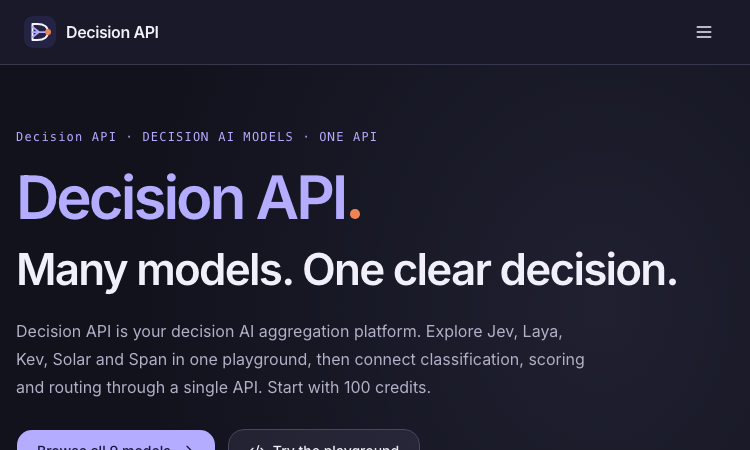
Decision API is a developer platform that aggregates decision AI models — Jev, Laya, Kev, Solar Decide, Span, Liquid, D1 and more — behind one playground and one unified API for classifying, scoring, and routing text. Instead of prompting an LLM and parsing prose, you send a state (a ticket, message, or record) plus structured questions and get back typed answers with probability distributions: a label (Choice), a rating along your rubric (Score), or a yes/no judgment with probability (Noul). Use it for customer-request routing, agent next-step selection, and claim-versus-evidence checking. An evaluation workspace lets you A/B test two models or question phrasings on the same cases before wiring one into production, and a single endpoint (POST /v1/systemone, Bearer auth) keeps the integration identical across all models — switching is a one-string change. New accounts get 100 free credits; paid packs are one-time ($10/$100/$1,000), credits never expire. Note: decisionapi.org is an independent platform — not the OpenAI Decisions API preview — and is the current home of the tool previously seen at decisions-api.org.
Explore App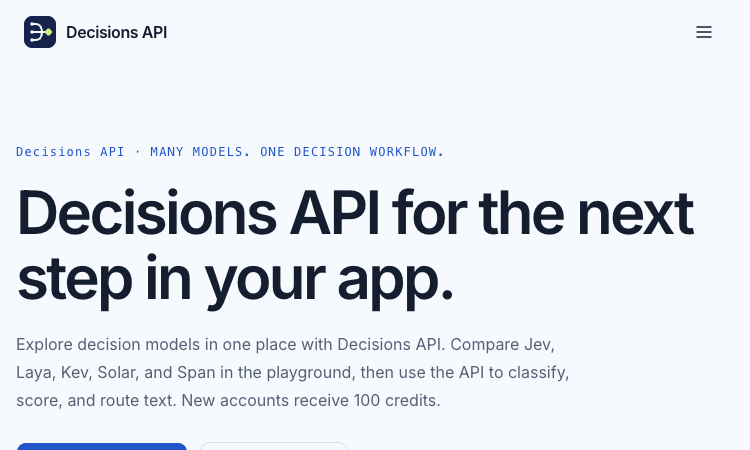
Decisions API
Decisions API – Official Website, What It Is & How to Use
Decisions API is an independent developer platform that brings multiple decision models — Jev, Laya, Kev, Solar Decide, and Span — into one playground and one unified API for classifying, scoring, and routing text. Instead of prompting an LLM and parsing prose, you send a state (a ticket, message, or record) plus structured questions and get back typed answers with probability signals: a label (Choice), a rating along your rubric (Score), or a yes/no judgment with probability (Noul). Use it for customer-request routing, agent next-step selection, and claim-versus-evidence checking. An evaluation workbench lets you A/B test two models or question phrasings on the same cases before wiring one into production, and a single endpoint (POST /v1/systemone, Bearer auth) keeps the integration identical across models. New accounts get 100 free credits; paid packs are one-time ($10/$100/$1,000) and credits never expire. Note: decisions-api.org is an independent platform, not the OpenAI Decisions API preview announced at DevDay.
Explore App
SdanceAI
Create short-form video with Seedance 2.5
SdanceAI is a browser-based Seedance 2.5 AI video generator and API service built for creators, marketers, developers, and production teams. Turn text prompts or reference images into short-form videos, adjust generation settings such as aspect ratio, duration, and resolution, track each task, and download completed videos as MP4 files. SdanceAI can support workflows for social media clips, advertisements, product launches, explainers, visual storytelling, and rapid creative testing. Developers can create an API key, submit generation tasks, monitor task status, and manage credit usage from the same platform. With a freemium, credit-based model and starter pricing from $9.90, SdanceAI makes Seedance 2.5 video creation accessible for individual experiments as well as automated application workflows. SdanceAI is an independent third-party product and is not affiliated with AI model providers.
Explore App
Twibird
Twitter bookmarks search made simple
Twibird is a Twitter bookmarks search tool designed for people who save valuable posts on Twitter/X and want an easier way to find them later. It turns a growing bookmark collection into a searchable personal knowledge library, helping users quickly rediscover useful threads, ideas, references, resources, and inspiration. Twibird reduces the time spent scrolling through old bookmarks and makes saved content easier to organize and revisit. It is useful for creators, researchers, marketers, founders, developers, and anyone who relies on Twitter/X for learning and discovery.
Explore App
GPT Image 2 API
Production-ready image generation and editing with GPT Image 2 API
GPT Image 2 API is a browser-based image generation and editing platform powered by GPT Image 2 for creators, designers, marketers, ecommerce teams, and developers. It turns detailed text prompts into polished images and supports targeted edits such as subject replacement, background changes, style updates, and local retouching. The platform is designed for practical creative work, including posters, product photography, advertisements, social media graphics, character sheets, comics, brand assets, and design mockups. GPT Image 2 API emphasizes readable text, stable composition, realistic materials, and consistent visual direction across multiple outputs. Users can export images in PNG or JPEG format, while developers can create API keys, submit image tasks, monitor task status, and manage credit-based usage from the dashboard. With freemium access and paid credits starting at $9.90, GPT Image 2 API gives both individuals and teams a flexible way to move from an initial concept to production-ready visual assets.
Explore App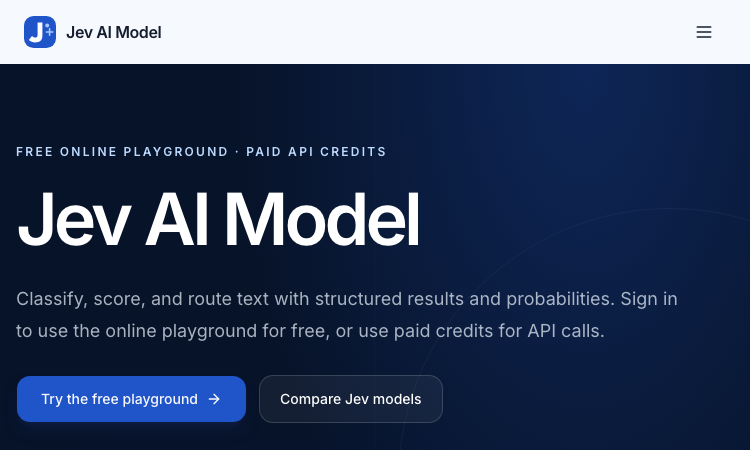
Jev AI Model
Jev AI Model – Official Website, What It Is & How to Use
Jev AI Model Official Website Jev AI Model is the model-focused home of the Jev decision engine: classify, score, and route text with structured results and probabilities — free online playground for signed-in users, paid credits for API calls. Official app: https://jevaimodel.net Creator: the Jev team (companion site to the Jev AI workspace at thejevai.com) Price: Freemium — playground free after sign-in; API usage via paid credits Login required: Yes — even the playground requires signing in Platform: Web playground + REST API (POST /v1/systemone) with a typed SDK Main use: Turning state plus typed questions (Choice / Score / Noul) into probability-backed decisions inside your code Last checked: 2026-09-23 Visit Jev AI Model We are not the official developer of Jev AI Model. This page helps users find, understand, and use the product. What Is Jev AI Model? Jev AI Model is not a chatbot — it is a decision model. You send state (a ticket, message, form fields, or the structured context your agent already sees) plus up to eight typed questions — Choice for classification, Score for ordered levels, Noul for yes/no — and one request returns typed answers with probabilities and confidence in 70–500ms, ready to branch on in code (if result.urgent: escalate()). This site adds two things the main product page doesn't. First, a published benchmark: JevBench v1.3.0 scores 52 systems across 534 decisions (snapshot Sep 21, 2026), with Jev 1.13.0 ranked #1 at 74.4, ahead of SemIf (73.1) and djev (73.0) — covering decision quality, probability calibration, speed, and cost per decision. Second, a 21-example interactive showcase with a clear specialty: agent trace evaluation — feeding an agent's tool-call trace into questions like taskcompletion, failuremode, and grounded_answer to grade whether an AI agent actually completed the task and whether its final response is grounded in its tool results. How to Use Jev AI Model Open the official Jev AI Model website and sign in — the playground is free for signed-in users. Pick one of the 21 decision workflows (e.g. agent trace evaluation) or build your own: enter state as Text or JSON. Define up to eight typed questions (Choice / Score / Noul), then click Generate decisions to see typed output with probabilities. Copy the POST /v1/systemone JSON preview, buy API credits, create a key, and wire the decision into your service via REST or the typed SDK. Is Jev AI Model Safe? The site runs on the jevaimodel.net domain over standard HTTPS and publishes API, Pricing, and Docs pages. Note the account gate: unlike the main Jev AI site, where the playground works without an account, here even the playground requires sign-in, and API calls use paid credits. Any state you send (tickets, messages, agent traces) leaves your system for classification, so treat customer-sensitive content accordingly — the same caution as any hosted AI API. The model's design supports safety use cases itself (pre-action checks around deletion and payment). No deceptive redirects were observed during review. Last checked September 2026. Why Is Jev AI Model Popular? As teams ship AI agents, evaluating and controlling them became the bottleneck of 2026: did the agent finish the task, is its answer grounded, when should a human step in? Jev AI Model answers exactly that with typed, probability-backed outputs — and backs its claims with a published, dated benchmark rather than adjectives. The free playground (just a sign-in) lets developers pressure-test it on a real scenario in minutes. Jev AI Model Not Working? If Jev AI Model fails to load: Refresh the page. Open it in another browser. Disable ad blockers temporarily. Check whether the original jevaimodel.net deployment is still online. Try again later if the developer is updating the app. Jev AI Model Alternatives Jev AI (thejevai.com) — the same decision engine with a no-login playground OpenAI Structured Outputs — typed JSON from GPT models you orchestrate yourself LangSmith — LLM/agent evaluation and tracing platform Frequently Asked Questions What is the official Jev AI Model website? The official website is https://jevaimodel.net. Is Jev AI Model free? The online playground is free once you sign in; API requests use paid credits. Do I need an account to use Jev AI Model? Yes — this site requires sign-in even for the playground (the companion thejevai.com playground needs no account). Who created Jev AI Model? The Jev team, which also publishes JevBench — an independent evaluation of decision-model quality across 52 systems. Is Jev AI Model still available? Yes, the site was live as of September 23, 2026.
Explore App