Overview
What PassMedicine is
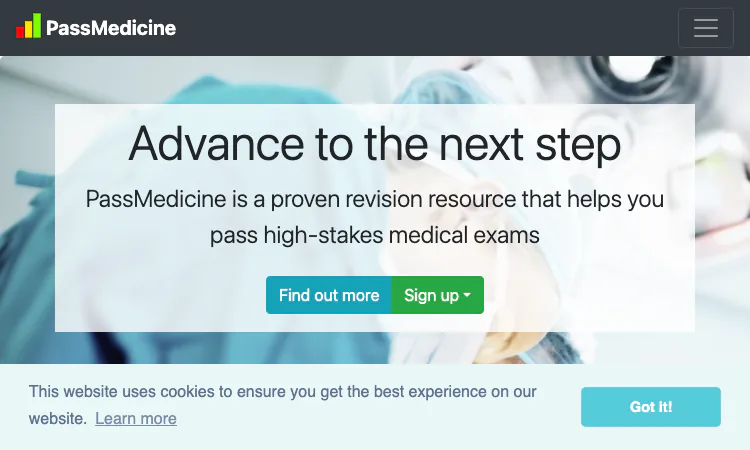
PassMedicine is an online revision resource for medical students and doctors preparing for high-stakes medical exams. The headline on the PassMedicine homepage reads "Advance to the next step", and the line under it describes the product plainly: PassMedicine is a proven revision resource that helps you pass. There is no app-store pitch and no lifestyle language anywhere on the page. What sits behind that homepage is a catalog of exam-specific question banks, each built around the format of a real exam in the UK medical training pipeline.
This profile looks at what PassMedicine actually contains and who it serves. The short version of the PassMedicine story: a large number of practice questions, arranged exam by exam, wrapped in study tools that measure how you are doing. The rest of this overview unpacks each of those three parts.
The question banks behind the name
The core of PassMedicine is its question banks, and the PassMedicine homepage prints the numbers rather than hiding them behind a login. The PassMedicine finals bank, which also serves candidates preparing for the UKMLA, holds over 12,000 single best answer questions, plus resources for the OSCE and the Prescribing Skills Assessment. The PassMedicine MRCP Part 1 bank holds over 5,400 single best answer questions, three full mock exams and a high-yield textbook. The MRCP Part 2 Written bank carries over 2,950 questions in the same SBA format.
For general practice, PassMedicine offers an MRCGP Applied Knowledge Test bank with over 4,900 questions, aligned to the updated 2025 RCGP curriculum. The PassMedicine bank for the 2027 Multi-Specialty Recruitment Assessment holds over 3,600 questions for the Clinical paper plus 300 Professional Dilemma questions. PLAB Part 1, the route international medical graduates take, has over 5,000 questions inside PassMedicine with a full mock exam included. There is also a PassMedicine DRCOG bank with over 1,000 questions, a 2026 UCAT bank with over 3,000 practice questions across the verbal reasoning, decision making, quantitative reasoning and situational judgment domains, and an F2 Situational Judgement Test bank with over 240 questions.
Two further banks widen the PassMedicine audience beyond doctors in UK training. A PassMedicine Pharmacy Registration Assessment bank serves pharmacy candidates, and a PassMedicine USMLE Step 1 bank offers 3,000 or more single best answer questions with flashcards driven by a spaced repetition algorithm. Early-year students are covered too: the PassMedicine years 1-3 bank holds over 4,700 SBA questions and an ANKI-style knowledge tutor. Every one of those banks lives under the same roof at passmedicine.com.
Built for the UK training pipeline
What makes PassMedicine coherent, rather than a pile of unrelated products, is that the banks map onto the real sequence of a medical career. You can arrive at PassMedicine as a first-year student, work through the years 1-3 bank and its knowledge tutor, move into the PassMedicine finals and UKMLA bank, and then step across into postgraduate banks as your training path becomes clear. A student who sits finals this year and starts an internal medicine job next year already knows where the PassMedicine MRCP Part 1 questions live.
The PassMedicine meta description lists the same exams by name: MRCP Part 1, MRCGP AKT, GP ST Stage 2, medical student finals, MRCP Part 2, the Situational Judgement Test, PLAB and DRCOG. PassMedicine presents its questions in the current format of each exam, which matters because question formats drift over the years and practicing on an outdated format teaches you the wrong reflexes.
PassMedicine also links to a family of partner sites covering exams outside its own banks: Intensive Anaesthesia for FRCA and FFICM, FRCEMtutor for MRCEM, PassMRCOG, PassPaeds for DCH and MRCPCH, MRCPsychMentor, eMRCS for surgical trainees and eFRCOphth for ophthalmology. The partners share the PassMedicine philosophy even where the PassMedicine name does not appear on their homepage.
Tools around the questions
Questions alone do not make a revision resource, and PassMedicine knows it. Each PassMedicine bank sits inside a shared set of study tools. PassMedicine revision mode lets you answer without a clock and read explanations as you go. PassMedicine timed tests put you under exam conditions. PassMedicine performance analysis breaks results down by topic, so weaknesses stop being feelings and become numbers. The PassMedicine question review functions let you return to past answers, and every question carries revision notes plus space for personal notes and a flag for later.
Two PassMedicine features deserve separate mention. The first is the candidate score histogram, which PassMedicine updates on a daily basis and which shows where your score sits relative to other candidates as a predictor of exam readiness. The second is the set of PassMedicine textbooks: syllabus-focused, high-yield, mapped to what the exam can ask, on the stated principle that you should only focus on what you need.
Where PassMedicine fits
The honest positioning is this: PassMedicine is not a course, a tutor or a motivational program. PassMedicine is a large, well-organised question bank with honest analytics attached. If your exam appears in the PassMedicine catalog, PassMedicine covers the format, the breadth and the feedback loop that revision needs. Pricing is not printed on the homepage, so check the PassMedicine site itself for current subscription terms before committing.
For anyone mapping out a revision plan, PassMedicine is a reasonable first stop, and for candidates in UK postgraduate training it is often the default answer when someone asks where to find practice questions. The scale of the banks, the daily-updated histogram and the exam-by-exam organisation are the three PassMedicine strengths worth remembering from this overview.
One more note for readers new to this corner of medical education: question-bank revision is a habit, not an event. The candidates who benefit from PassMedicine are the ones who answer a block of questions every day and let the PassMedicine analytics accumulate, not the ones who binge a bank in the final fortnight. The resource is designed around that daily rhythm, from the daily histogram refresh to the per-question notes you build up over months. Visit, pick your exam, and start a PassMedicine question set the same day.
Related apps

MemoryMaster Pro
Master the art of memory with interactive techniques.
MemoryMaster Pro is an interactive web platform designed to help you master powerful memory techniques. Using methods like the Link Method and Peg System, our trainer lets you…
Explore App
Flo App
Flo App is the AI-powered period, ovulation, and pregnancy tracker trusted by millions of women.
Flo App Flo App is the leading female health companion, designed to turn the chaos of cycle tracking, symptom logging, and pregnancy planning into a calm, evidence-based daily…
Explore App
Jivana
Jivana: Harmonize Your Day with Mindful Living
Jivana is a thoughtfully designed wellness and productivity app that helps you create a balanced, healthy, and meaningful daily life. Inspired by the wisdom of ancient Indian…
Explore App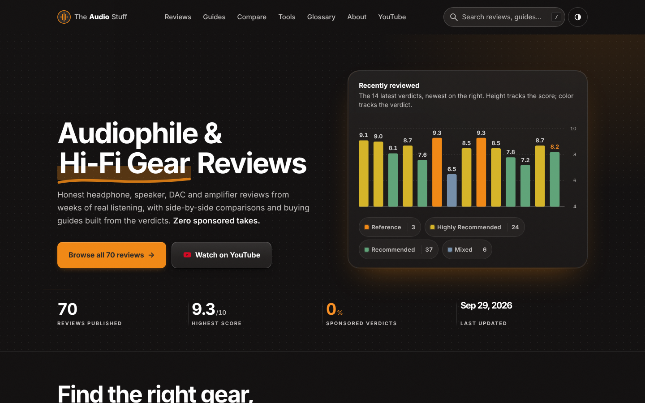
The Audio Stuff - Reviews & PRO Tools
Headphone, DAC and speaker reviews written after weeks of living with the gear, plus 17 free browser tools like an ABX test and a power calculator.
Hi, I'm Jakub. I run The Audio Stuff, a hi-fi review site I started in 2023 because I was tired of reviews that read like press releases. These days it's me and one other…
Explore App
ADHD Test
ADHD Test - a research-backed ASRS v1.1 screener with an optional AI personalized report.
ADHD Test ADHD Test shows how a focused web tool can take a respected clinical instrument and make it approachable for everyday adults. The product is built around the ASRS v1.1…
Explore App
MoodMeals — Dinner Ideas You’ll Actually Cook
Tell me your mood & pantry. Get dinner in 5.
Tired of doom-scrolling recipes you’ll never make? Tell MoodMeals how you feel (cozy, speedy, budget, impress), what’s in your pantry, your time limit, and servings. You’ll get…
Explore App