Overview
What Sogni AI Actually Is
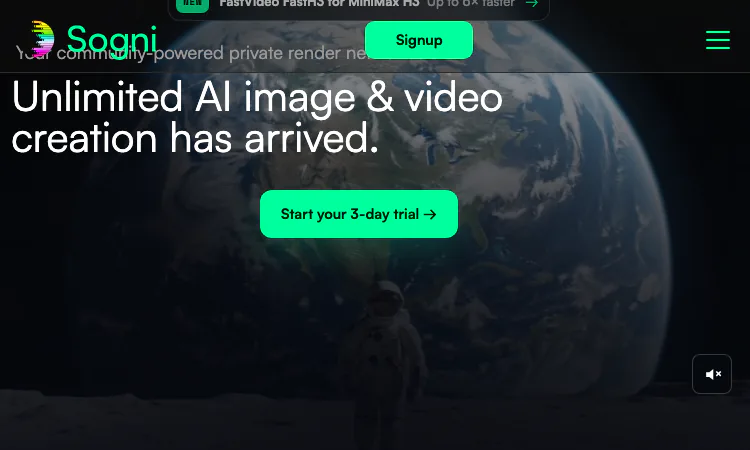
Most people meet generative art tools one at a time. A subscription here for photorealistic images, another one there for short video clips, a third for voice work. The bills stack up and the outputs still do not talk to each other. Sogni AI starts from the opposite premise: one account, one workspace, and more than two hundred creative models behind it.
The site's own title calls it a "Free AI Image & Video Generator" with "200+ Creative Models", and that is a fair one-line summary. Under the hood it is a rendering platform. You describe what you want, pick a model, and the work is dispatched to the Supernet, a decentralized GPU network run on idle compute contributed by people rather than a single data center. For a plain overview, that is the whole shape of the product: prompt in, finished image or video out, with a model library most single tools cannot match.
Why a Network of Ordinary GPUs
Rendering images and video is the expensive part of AI creativity. A single high-end card chews through one job at a time, and buying a rack of them is out of reach for almost everyone. Sogni AI sidesteps this by treating distributed GPUs as one shared pool. When you submit a job, spare capacity somewhere on the network picks it up.
This design has a practical consequence for users: capacity scales with the community. Sogni AI does not need to queue every free-tier user behind one bottleneck. It also lets the platform host open-weight models without restrictive filters, because the rendering happens on member machines rather than a corporate cloud with a compliance team. That is why 190+ of its image models carry permissive policies, and why 50+ community fine-tunes sit alongside them.
What You Can Make With It
The model list covers four media types. For images there are general engines like Krea 2 Turbo and FLUX 3 Image Klein alongside GPT Image 2.5. For video, MiniMax H3 and FastH3 produce clips with synced audio, and LTX 2.5 handles lighter motion work. Music and voice come from models such as Qwen3-TTS. Pixal3D adds 3D asset generation to the same library.
Beyond single generations, Sogni AI strings steps together. Prompt-to-storyboard turns a sentence into a scene breakdown. Storyboard-to-video animates those panels into a coherent sequence. There are dedicated workflows for lipsync, motion transfer, 360-degree camera moves, voice identity transfer, and image upscaling that reaches 16K resolution. FlashVSR can upscale finished video to 2K.
If you maintain your own LoRA files, the platform accepts custom imports from Hugging Face and Civitai. That matters for anyone who has trained a style on their own work and wants to keep using it without hosting a rig. In effect, Sogni AI behaves like a rented studio that lets you bring your own brushes.
Browse the shelf by medium rather than by vendor. A typical Sogni AI session touches two or three models in an hour — a still, an upscale, a voice line — with no re-uploading between steps and no second subscription. Sogni AI keeps switching cost near zero, which quietly changes behavior: you compare engines instead of settling for the one you already paid for. In daily use, Sogni AI treats the model as the variable and the workspace as the constant.
The Apps and the API
There are two native applications. Studio is the desktop-style workspace for serious sessions with layered workflows. Pocket is the lighter companion for phones, with iOS and Android apps for generating on the move. The same account carries credits and history across all of them.
Developers get an OpenAI-compatible REST API plus SDKs and TypeScript clients. There is even a "Sogni Creative Agent Skill" designed for agent frameworks like Claude and Codex, which lets an automated assistant call the same rendering endpoints you use manually. A small team could wire Sogni AI into a content pipeline and never open the web app at all. Continuity across surfaces is the understated feature here. A prompt drafted on the phone during a commute, finished in Studio at a desk, then called from a script overnight — Sogni AI keeps those sessions in one library with one Spark balance, so nothing about the work is trapped in a single app.
Pricing in Plain Terms
The free tier exists and is genuinely usable: you receive filtered monthly Spark credits and need no GPU of your own. Spark is the platform's credit unit, and premium partner models are billed pay-as-you-go in Spark on every plan. The Unlimited plan, from $20 a month with a 3-day free trial, covers credit-free fair-use rendering on eligible open-source models. Heavy users of open weights get flat-rate pricing, while premium models stay metered.
There is one more side to the economics. People with idle graphics cards can join the Supernet as workers and earn from their spare compute, paid in Spark or SOGNI. The same platform is a consumer tool for creators and a small income source for hardware owners.
How Sogni AI Compares on Breadth
Against single-purpose generators, the difference is scope: one engine family versus 200+ creative models across image, video, voice, and 3D, with workflows connecting them. Against the all-in-one suites of large vendors, the difference is openness. Sogni AI runs open weights beside premium partner models, and its permissive stance on 190+ image models speaks to artists who keep hitting policy walls elsewhere.
The site's comparison pages name the target audience directly — people switching from Civitai, comparing ChatGPT images, leaving Leonardo AI, weighing Venice AI. Sogni AI is built as a consolidation point for creators scattering work across several narrow tools.
Who It Suits, Honestly
Sogni AI fits three groups well. Artists who want breadth — many styles, video plus stills, custom LoRAs — get it in one place. Developers who want image or video generation behind a familiar REST API get that without managing inference servers. Casual users get a free starting point that does not require hardware.
It fits less well if you need strict content policies for a corporate brand channel, since much of the library is deliberately permissive. And if your work lives inside one narrow model you already pay for elsewhere, a second platform may be redundant. The comparison pages on the site — switching from Civitai, leaving Leonardo AI, weighing Venice AI — suggest Sogni AI is aimed squarely at people consolidating several tools into one.
For everyone else, the honest pitch is simple: Sogni AI is a free-to-start creative renderer with an unusually wide model shelf and a community-run GPU network underneath, and the free Spark credits let you judge the output quality before any money changes hands. That trial-sized start is the right way to meet Sogni AI: with your own prompts, your own Spark, and your own verdict.
Related apps
Ideal Photo Vercel
Ideal Photo Vercel- an AI photo booth app that builds shareable, multi-frame portrait strips from one photo.
Ideal Photo Vercel Ideal Photo Vercel reimagines the classic photo booth as a fast, web-based AI utility. From a single uploaded photo, the tool generates a clean, four-panel…
Explore App
AIEnhancer
AIEnhancer – Official Website, What It Is & How to Use
AIEnhancer Official Website AIEnhancer is an all-in-one AI workspace for enhancing and creating photos, images, and videos, with 27 production-ready models and guided creative…
Explore App
Vidu Q4 AI Video Generator
Vidu Q4 AI video generator — a practical overview and first steps for makers and curious users.
Vidu Q4 AI Video Generator Vidu Q4 is an AI video-generation model on the Vidu platform. Its official page emphasizes image-to-video and reference-to-video workflows, with…
Explore App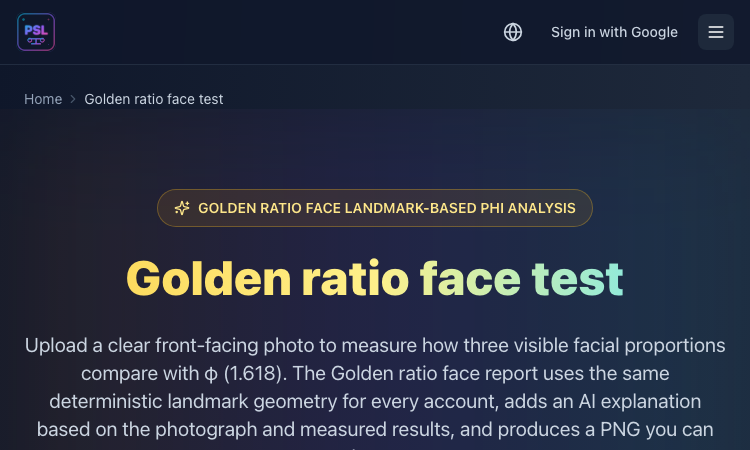
Golden Ratio Face
Golden Ratio Face - Browser facial analysis that scores three proportions against phi (1.618) and a harmony score.
Golden Ratio Face Golden Ratio Face is a browser-based facial analysis tool that compares three facial proportions against the golden ratio φ (approximately 1.618) and returns an…
Explore App
Void Magic AI
Void Magic AI – Official Website, What It Is & How to Use
Void Magic AI Official Website VoidMagic AI is a creative toolkit for face swaps and voice creation: swap faces in photos, videos, and GIFs, or build reusable AI voices — in one…
Explore App
UniFab AI Video Upscaler
UniFab AI video upscaler — a practical overview and first steps for makers and curious users.
UniFab AI Video Upscaler UniFab AI Video Upscaler is part of UniFab’s video enhancement and restoration software. It is aimed at people who want to improve the apparent clarity…
Explore App