Overview
What NanoGPT Is
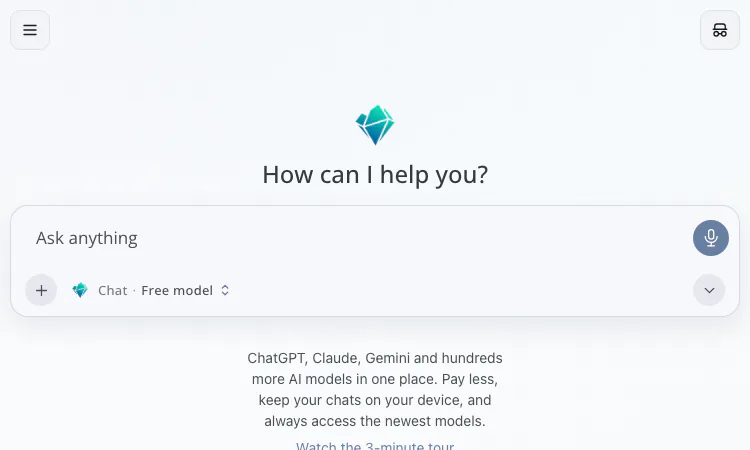
Open one tab for ChatGPT, another for Claude, a third for Gemini, and a fourth for an image generator. Each service wants its own account, its own subscription, and its own monthly guess about how much you will use. NanoGPT starts from a different premise: one site, one prepaid balance, and every model behind a single input box.
NanoGPT is a web platform that gathers AI models from many labs into one place. The NanoGPT tagline is blunt: "ChatGPT, Claude, Gemini and hundreds more AI models in one place." At the time of writing, the NanoGPT catalog lists more than 1,200 models from 119+ AI labs, and the site reports that 113 of them were added in the past month. When a new model starts mattering, it tends to appear on NanoGPT quickly, which is a large part of the point.
One Account, Every Modality
The catalog is not only chat models. NanoGPT groups what it offers by modality: 652 text models for chatting, coding, writing, and reasoning; 231 image models for generating, editing, and upscaling; 187 video models that turn text or images into clips; 109 audio models for speech, voices, and music; and 15 models for 3D work. NanoGPT also keeps a small "decisions" category that is API only.
The labs behind those numbers are the ones you would expect and several you might not. On NanoGPT, OpenAI accounts for 57 text models, Anthropic for 32, Google for 24, and xAI for 8. Alongside them sit Qwen with 78, Z.AI with 39, DeepSeek with 21, Mistral with 21, Moonshot AI with 14, MiniMax with 11, NVIDIA with 11, Xiaomi with 10, and Meta with 8. NanoGPT is one of the few places where all of these families appear in one searchable list, and the NanoGPT count keeps moving as labs ship.
Pay As You Go, From Ten Cents
The NanoGPT pricing model is prepaid rather than subscription-first. You top up a balance and pay only for what you use, with NanoGPT deposits starting at $0.10 in crypto or $1 by card. NanoGPT charges no deposit fees, and billing is by token, which the site translates as roughly four tokens for every three words. Input and output tokens are billed separately, which is the standard convention across the industry.
There is also a NanoGPT subscription, priced at $12 per month, for people whose usage justifies it. It includes 60 million input tokens per week, free output on the covered open-source models, and 100 images per day on four image models. The NanoGPT allowance resets every Monday at 00:00 UTC. Closed models such as Claude, GPT, Gemini, and Grok are not covered by the subscription and still draw from your balance.
Chats Stay on Your Device
One design choice on NanoGPT deserves its own section: chat history is kept on your device rather than on the company's servers. For people who paste sensitive work documents into a chat window, that is a meaningful default for NanoGPT to ship. It also matches the "Private AI" branding the NanoGPT site uses for itself.
The practical effect is that your NanoGPT conversations travel with your browser, not with some remote dashboard tied to your login. Clear your local storage and the history is gone from NanoGPT with it, with no server-side copy left behind on the NanoGPT side. Whether that is a feature or a limitation depends on how you work, but NanoGPT at least makes the tradeoff explicit instead of burying it in a policy page somewhere on the NanoGPT site.
An OpenAI-Compatible API
Developers get the same idea in code form. NanoGPT exposes an OpenAI-compatible API, which means most existing tools, SDKs, and helper libraries that speak to OpenAI endpoints can be pointed at NanoGPT with a changed base URL and a new key. One NanoGPT integration then reaches the whole catalog of models.
The NanoGPT API keeps costs legible in a way many providers do not. Every response from NanoGPT includes the exact cost charged for that call, so a script can log its own spending without estimating anything. NanoGPT also states that API prices are list prices with no markup: a model that costs $5 per million input tokens and $30 per million output tokens at its original provider costs exactly $5 and $30 on NanoGPT.
Benchmark data is part of the overview too. NanoGPT tracks 114 benchmarks from 8 independent sources and publishes scores for 288 of the models in its catalog, rolled into what the site calls the NanoGPT Composite. That gives a new NanoGPT user a starting point for choosing between models, beyond guessing from names. The NanoGPT catalog also highlights task-based picks for coding, creative writing, roleplay, and math, which narrows the field before you spend anything.
What to Know Before You Start
A fair assessment of NanoGPT has to include the edges. The free NanoGPT tier includes one free model, available on the web only, which is enough to test the NanoGPT interface but not enough to judge the whole catalog. NanoGPT subscribers who manually pin a specific provider pay a 5% surcharge on those requests, and bring-your-own-key requests through NanoGPT are billed at 5% of the normal model cost. Subscribers do get a 5% NanoGPT discount on eligible paid text models, which partly offsets the surcharge. These are small numbers that are easy to miss when you start.
Against that, NanoGPT solves a real coordination problem. Instead of managing five vendor relationships, five invoices, and five sets of rate limits, a NanoGPT user manages one balance. Instead of re-implementing an integration per provider, a NanoGPT developer implements one. The NanoGPT value is not that any single model becomes cheaper; it is that the cost of switching between models drops close to zero. For anyone whose work depends on comparing what different labs are shipping, NanoGPT is a straightforward way to keep up without collecting subscriptions, and a reasonable place to start consolidating an increasingly crowded toolbox.
Related apps
All Tools Lutfizzx Vercel App
All Tools Lutfizzx Vercel App is an all-in-one developer hub for OSINT, AI, and web utilities.
All Tools Lutfizzx Vercel App All Tools Lutfizzx Vercel App is an all-in-one professional developer hub that brings OSINT, artificial intelligence, and web utilities together…
Explore App
Agent Mindshare
Vibe SEO/GEO tool with MCP and BigQuery export
AI agents are becoming the primary interface between businesses and their customers. We're building the intelligence layer that ensures your brand stays visible and influential…
Explore App
TruAI
Speak your truth (or not)—see what AI thinks!
Freesoragenerator
Freesoragenerator – Official Website, What It Is & How to Use
Freesoragenerator Official Website Freesoragenerator (FSG AI) is a free online AI video generator built around Grok Imagine-style generation — text-to-video and image-to-video…
Explore App
Visual to Code AI
From pixels to production code at the speed of imagination.
Transform your designs into working code instantly with our Image-to-Code AI. Upload a screenshot, mockup, or UI design, and watch it generate clean, developer-friendly code.…
Explore App
EPIC
Create Visual Sitemaps for your website
EPIC is a browser-based design and layout builder that combines manual creative control with structured navigation tools. Unlike heavy design software, EPIC focuses on speed,…
Explore App