Overview
Tavily, Explained: A Web Access Layer for AI Agents
Ask a language model what happened in the news this morning and you get one of two answers: a polite refusal, or a confident paragraph that is partly invented. The model is not broken. It simply has no window into the live web, and pretending otherwise produces hallucinations. Tavily exists to close that gap. Tavily gives AI agents one API for retrieving real-time web data, cleaned and structured, so the model reasons over facts instead of guesses.
The company describes Tavily as a web access layer for AI agents, now operating as Tavily by Nebius after joining the Nebius group following a $25M Series A reported by TechCrunch in August 2025. That framing matters. Tavily is not a consumer search engine with an API bolted on. Every part of Tavily, from result formatting to rate limits, is designed for programs that consume the output, not for humans browsing ten blue links.
The Gap Tavily Fills
A typical large language model has a training cutoff. Everything after that date is invisible to it. If you build a chatbot, a research assistant, or an automation that needs current information, you have to fetch that information yourself. Doing it well is harder than it sounds.
You need a search index, because querying a generic search API returns pages of links rather than material a model can read. You need a scraper, because the links must be followed. You need a parser, because raw HTML is mostly navigation bars, cookie banners, and script tags. Then you need filtering, because some pages contain prompt-injection attacks aimed at your agent. Tavily collapses this whole stack into a single service. The agent asks a question; Tavily returns web content that is ready to drop into a prompt.
Five Endpoints, One API
Tavily exposes five endpoints, and each maps to a distinct job in an agent pipeline.
Search is the workhorse. Tavily returns fast, relevant web results for a natural-language query, with parameters such as search_depth, max_results, and include_answer to tune cost against thoroughness. Extract pulls clean, structured content out of specific URLs, stripping the boilerplate a model does not need. Crawl extends extraction across entire websites, which is useful when an agent must read full documentation or a complete news archive. Map discovers the URL structure of a site without fetching page bodies, so you can scope a crawl before paying for one. Research goes further and runs an agent for in-depth web research, chaining multiple retrievals into a synthesized result.
Underneath these endpoints sits plumbing you do not see when you call Tavily: intelligent caching, indexing, blocking of PII leaks, and filtering of prompt-injection and malicious sources. The last two are easy to overlook until an agent reads a page that instructs it to ignore previous directions. Tavily treats that class of attack as a retrieval problem, not an afterthought.
Numbers Worth Knowing
Tavily reports 180 ms median latency on its search endpoint, which the company calls the fastest on the market, and the service handles over 300 million requests each month. Availability is backed by a 99.99 percent uptime SLA. On benchmarks like SealQA and SimpleQA, Tavily claims the top position, and the company publishes a Company Search benchmark with open methodology on Hugging Face, so anyone can check the scoring rather than trust a marketing chart.
For teams with compliance requirements, Tavily lists SOC 2, ISO 27001, GDPR, and a zero-data-retention policy. These are the certifications procurement departments ask about before an agent that touches customer data is allowed into production.
Who Trusts Tavily
More than three million developers have signed up for Tavily, according to the company's counter. The named customer list for Tavily runs from JetBrains, MongoDB, and AWS to Mastercard, IBM, Groq, LangChain, and Monday.com, which suggests Tavily works at both the weekend-project scale and the enterprise scale. For larger deployments, Tavily offers dedicated solutions for financial services, insurance, and post-training data work, where freshness and provenance of web data carry direct business risk.
Pricing for Tavily follows a usage model. The free Researcher plan gives 1,000 API credits per month with no credit card required, pay-as-you-go costs $0.008 per credit, the Project plan is $30 per month with 4,000 credits and higher rate limits, and Enterprise is quoted custom. Students can use Tavily at no cost, and accepted startups get 100,000 free credits with hands-on support. A credit is consumed per request type, and heavier requests such as deep crawls cost more than a basic search.
An Honest Closing Look
Tavily is not a substitute for a reasoning model, and Tavily does not pretend to be. What Tavily does is solve the unglamorous retrieval layer: finding pages, cleaning them, structuring them, and keeping hostile content out of your prompt. If your agent needs current facts from the open web, that layer has to exist somewhere. Building it yourself means maintaining scrapers, parsers, and blocklists that decay every month. Renting it from Tavily means paying per credit and getting a team that treats web retrieval as its entire product.
The reasonable objection is dependency: you are trusting one company's index and ranking for your agent's worldview. Tavily answers that objection with published benchmarks and compliance audits, but the trust question never fully disappears with any search provider. A practical mitigation is architectural rather than contractual: because every Tavily response carries its source URLs, an agent built on Tavily can still show its work, and a human can still click through and check the primary page that Tavily cleaned. Retrieval through Tavily narrows the trust question from "is the answer right" to "are these sources right", which is a question a user can actually answer. For most teams, the free tier makes experimenting with Tavily cheap, the latency numbers make Tavily practical, and the five-endpoint surface keeps the integration small enough to swap later if needed. That combination, more than any single feature, explains why Tavily shows up inside so many agent stacks, and why Tavily keeps appearing in the toolchains of teams that ship agents to real users.
Related apps
Decisions API
Decisions API – Official Website, What It Is & How to Use
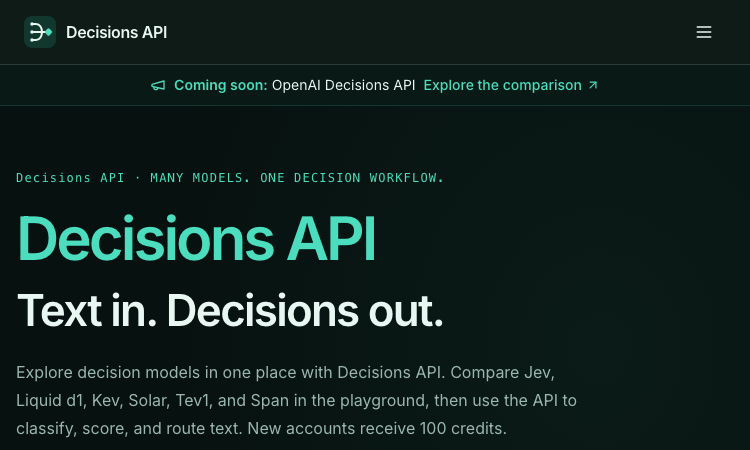
Decisions API (decisions-api.dev) is a developer platform that aggregates decision AI models — Jev, Laya, Kev, Solar Decide, Span, Liquid, D1 and more — behind one playground and…
Explore App
GPT-6 Luna Decisions
GPT-6 Luna Decisions gives your apps decision intelligence: Choice, Score, and yes/no answers with probabilities from text, JSON, or images.
GPT-6 Luna Decisions GPT-6 Luna Decisions brings decision intelligence to the apps you build, without asking you to run models or design prompts from scratch. Listed on Decisions…
Explore App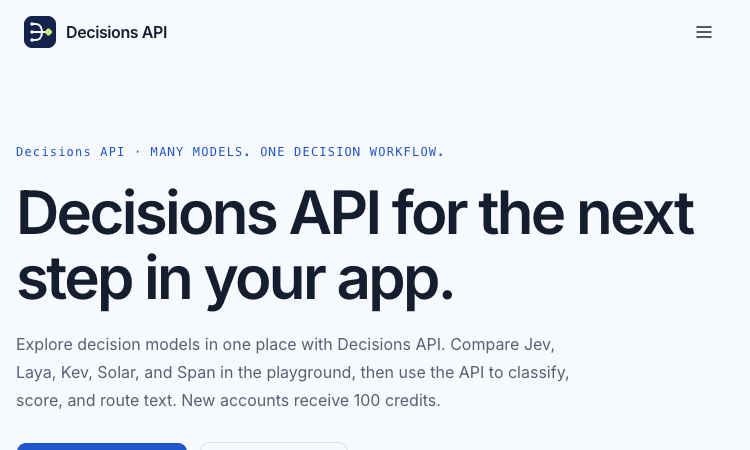
Decisions API
Decisions API – Official Website, What It Is & How to Use
Decisions API is an independent developer platform that brings multiple decision models — Jev, Laya, Kev, Solar Decide, and Span — into one playground and one unified API for…
Explore App
Nous Portal
Nous Portal — manage API keys, usage, and account settings for Nous Research's Hermes models.
Nous Portal Nous Portal is a developer-first control panel for working with Nous Research's open source language models and the Hermes Agent. It brings every operational task —…
Explore App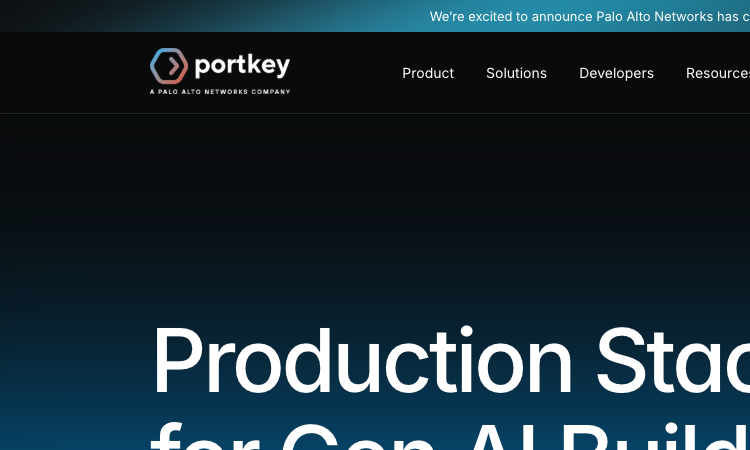
Portkey
Portkey — one AI Gateway to 1,600+ LLMs with caching, routing, and fallbacks for production-ready apps.
Portkey Portkey is an AI Gateway that gives teams unified access to more than 1,600 large language models through a single API. Instead of writing and maintaining bespoke…
Explore App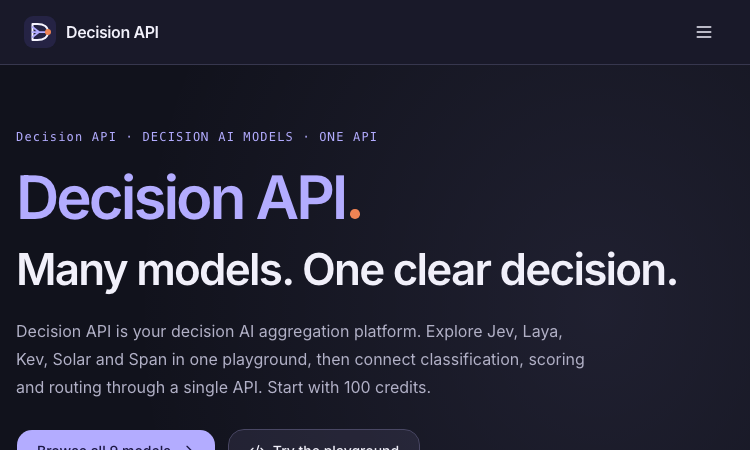
Decision API
Decision API – Official Website, What It Is & How to Use
Decision API is a developer platform that aggregates decision AI models — Jev, Laya, Kev, Solar Decide, Span, Liquid, D1 and more — behind one playground and one unified API for…
Explore App