Overview
A production team compressed into a text box
Making a ten-minute documentary used to require a small company of specialists. One person researched the topic, another wrote the script, a voiceover artist recorded the narration, an editor assembled the footage, and a motion designer animated what no camera could cover. The bottleneck was rarely any single craft. The bottleneck was the relay between five calendars.
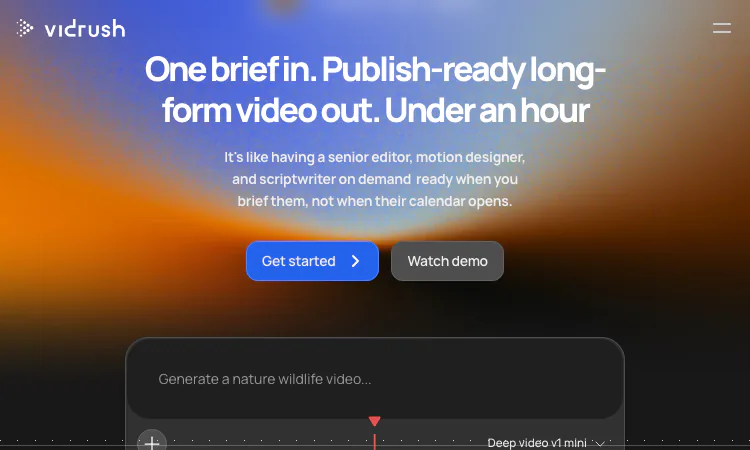
VidRush is built directly against that relay. VidRush is an AI production team for long-form video: you submit a written brief, and VidRush returns a finished video with research, script, voiceover, footage, editing, and thumbnails included. The VidRush homepage compresses the pitch into one line: one brief in, publish-ready long-form video out, under an hour.
That line deserves unpacking rather than repetition. This profile covers what VidRush produces, how the internal pipeline is organized, where a human still makes the calls, and what the service charges. Everything below is grounded in what the product states about itself, including its stated limits.
The output, defined precisely
The unit of work in VidRush is the long-form video: six to sixty minutes, rendered in English today. The VidRush homepage names four shapes of output, and all of them are narration-driven: documentaries, explainers, breakdowns, and top-ten listicle videos. Each rests on a scripted voiceover, with sourced footage underneath and motion elements carrying the argument where clips run out.
The supporting material ships with the render. VidRush generates thumbnails alongside the video, and the soundtrack is original music rather than a loop from a shared library. For channels that have been copyright-claimed over background audio in the past, that VidRush detail is practical rather than cosmetic.
Briefs can be written in English, German, or Spanish. Output remains English for now, so the multilingual brief is an input convenience inside VidRush rather than a localization feature. VidRush does not pretend otherwise, which is worth noting.
Five specialists, one timeline
Internally, VidRush simulates a crew of five: a researcher, a scriptwriter, a motion designer, an editor, and a sound designer. The framing sounds decorative until you notice how the roles connect. The researcher gathers what the script needs, the scriptwriter shapes the narration, the editor marries footage to beats, and the motion designer fills the gaps that remain.
Because the five roles run against one brief in parallel, VidRush does not hand work down a hallway. The parts converge on a single timeline, which is how the first cut of a VidRush video arrives in under an hour instead of next Tuesday.
For the creator, the difference is latency. A freelancer pipeline returns a first draft in days. On VidRush, the review loop rather than the render becomes the pacing constraint, and review is the part you control directly.
Where the human stays in charge
The strongest design decision in VidRush is the approval gate. Before any rendering starts, you review the script, the planned footage, the voice, the style settings, and a cost estimate. Nothing is produced until you accept those choices, which inverts the familiar pattern of a tool generating first and apologizing afterward.
Revision inside VidRush then works two ways. You can instruct the service through chat in plain English, as you would brief an editor, or you can open a manual timeline and cut by hand. Editing in VidRush is non-destructive: trimming, replacing, or retiming one clip does not regenerate the whole video, so a small fix stays a small fix.
Footage sourcing is equally explicit. VidRush can restrict itself to public domain and Creative Commons material, use commercial stock, or crawl the general web. Channels with strict licensing policies can hold VidRush to the first mode and stay defensible.
Cost, stated plainly
VidRush prices finished video by the minute, from $2.18, with plans from $99 a month that push the rate below $2 at scale, and yearly billing saving 20 percent. A sibling VidRush product line, Persona I, produces AI avatar videos from $0.53 per minute. The structural detail is that VidRush shows the cost estimate before rendering begins, beside the script approval, so the price of a video is visible while it can still be changed.
Signals worth noting
A few stated numbers help size the operation. VidRush reports 100K+ creators served, 40,000+ videos produced, and 3 billion long-form views across its catalog. Numbers like these are marketing until the output holds up, but they do tell you the VidRush pipeline has run at volume, which is the relevant question for a service selling hours instead of days. The volume also explains the channel-matching: VidRush learns pacing, motion, and editing rhythm from a real catalog, and a catalog of that size gives the matching something substantial to learn from.
For a first evaluation, the entry is small: one real brief, one script review at the approval gate, one VidRush draft in under an hour. That is enough exposure to judge whether the VidRush rhythm fits your channel, and the per-minute estimate at the gate tells you what the experiment costs before it runs. VidRush is, in that respect, unusual among AI video services, which more often ask for trust first and show pricing later.
Who it suits, and who should pass
The intended users are YouTube creators running documentary, finance, true crime, science, geopolitics, or explainer channels. The operator, VidRush AI Studios LLP, states the boundary plainly: vlogs, gaming content, and vertical Shorts or Reels are out of scope. That candor helps, because it signals that VidRush is tuned for scripted narration rather than talking-head spontaneity, and that distinction is the whole product.
An enterprise VidRush offering, Atlas, is listed as coming soon, aimed at newsrooms, broadcasters, and rights holders repurposing their own licensed archives. For teams in that position, VidRush is showing where the roadmap goes next.
If your channel runs on researched narration, VidRush replaces coordination with approval. You still decide what is worth saying. The VidRush pipeline supplies the crew, the timeline, and a deadline you can plan a publishing calendar around.
Related apps
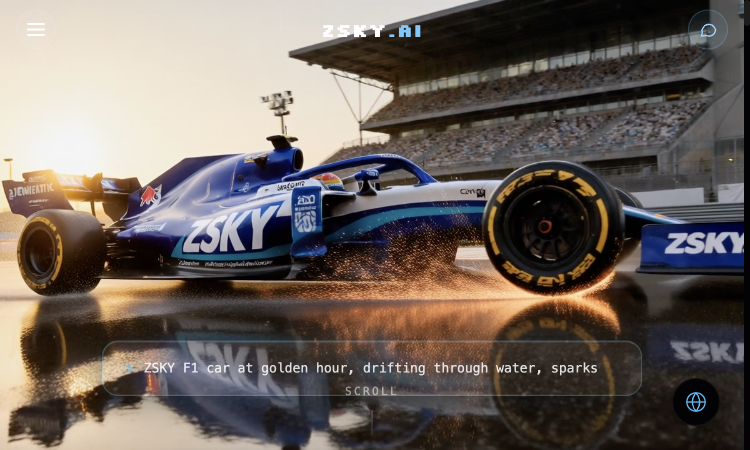
ZSky AI
ZSky AI — Explore the core workflow and practical use cases in one concise product listing.
ZSky AI: A Practical Overview ZSky AI is an online image and video creation studio that combines prompt-led generation, image editing, and image-to-video workflows. This listing…
Explore App
Cinegram
Video Greetings that Speak
Go beyond generic e-cards and bring your heartfelt messages to life with Cinegram, the app that turns your words into stunning, AI-powered video greeting cards with custom…
Explore App
Palmier Io
Palmier Io - an AI-native desktop video editor with multi-model AI generation on the timeline.
Palmier Io Palmier Io is an AI-native video editor built for creators who want to generate and edit AI media in one continuous workflow. Instead of juggling separate AI…
Explore AppMelodycraft Ai
AI-powered music generator for creating professional royalty-free tracks in seconds.
🎵 What is Melodycraft AI? Melodycraft AI is an advanced music generation platform designed for content creators, musicians, and developers. It empowers you to create…
Explore App
Life Path Calculator
Life Path Calculator - the fastest free numerology web app: instant results, no sign-up, and shareable reading cards.
Life Path Calculator 🎯 Key Takeaways (TL;DR) The Life Path Calculator is a free, no-sign-up web app that reveals your Life Path Number from your date of birth in seconds. The…
Explore App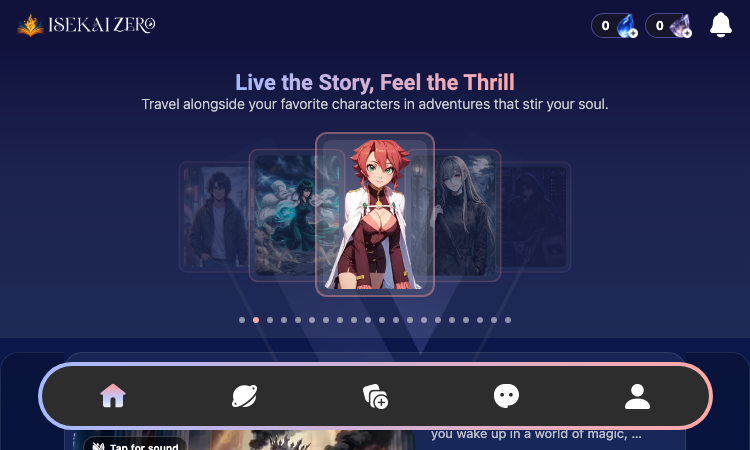
Isekai Zero
Isekai Zero drops you into immersive visual-novel AI adventures alongside a memorable cast of characters.
Isekai Zero Isekai Zero is an interactive AI storytelling platform that brings the beloved isekai genre to life through immersive visual-novel adventures. The tagline "Live the…
Explore App