
Overview
Pi Agent
Pi Agent is a minimal, terminal-based coding agent built around the idea that the harness should adapt to the developer instead of forcing the developer to adapt to the harness. Hosted at https://pi.dev/ and shipped by Earendil Inc., Pi Agent runs as a TUI in the terminal, exposes a tree-structured session history, supports skills, AGENTS.md and SYSTEM.md context files, and is unusually token-efficient thanks to a minimal default system prompt. The product's tagline is "There are many agent harnesses, but this one is yours."
Pi Agent ships in four runtime modes. Interactive mode delivers the full terminal UI with rich keyboard shortcuts and a stylable interface. Print mode runs Pi Agent headlessly with a single query for use inside shell scripts. JSON mode streams structured events from a Pi Agent run for piping into other tools. RPC mode exposes Pi Agent over JSON over stdin/stdout so non-Node processes can drive it. An SDK lets developers embed Pi Agent directly into their own applications. The product documentation points to OpenClaw as a real-world example of that SDK being used.
The model layer is provider-agnostic. Pi Agent works with Anthropic, OpenAI, Google, Azure, Bedrock, Mistral, Groq, Cerebras, xAI, Hugging Face, Kimi For Coding, MiniMax, NVIDIA, OpenRouter, Ollama and more than fifteen other providers in total. Authentication can be done with API keys or OAuth. The /model command and Ctrl+L shortcut switch models mid-session, while Ctrl+P cycles through favourites. Custom providers and models can be added through a models.json file or extensions.
Context engineering is central to Pi Agent. The platform loads AGENTS.md project instructions from ~/.pi/agent, parent directories and the current directory, supports per-project SYSTEM.md overrides, auto-summarises older messages via compaction, and ships a skills system for capability packages loaded on demand. Prompt templates let developers reuse common prompts as Markdown files. Extensions, written in TypeScript, can inject context before each turn, filter message history, implement RAG or build long-term memory. Sessions can be branched, shared, exported to HTML, or pushed to a GitHub gist with /share to obtain a shareable URL.
Pi Agent is built for developers who want to customise their coding workflow rather than accept whatever defaults a closed product provides.
Related apps
Jev AI Model
Jev AI Model – Official Website, What It Is & How to Use
Jev AI Model Official Website Jev AI Model is the model-focused home of the Jev decision engine: classify, score, and route text with structured results and probabilities — free…
Explore App
Steam Manifest
Steam Manifest - One-click tool to fetch Steam application manifests by App ID for use with SteamTools.
Steam Manifest Steam Manifest Hub is a free static-site utility for Steam users who want to download application manifests by simply entering a Steam App ID. The page lives on…
Explore App
Granola App
Granola App is the AI notepad for back-to-back meetings that turns spoken conversations into editable notes.
Granola App Granola App is built for the knowledge worker whose week is dominated by back-to-back meetings. Instead of forcing a choice between listening carefully and taking…
Explore App
Ponytail Github
Ponytail Github - AI-coding skill that makes your agent write 54% less code and stay 100% safe.
Ponytail Github Ponytail Github is an open-source AI-coding skill that turns over-eager AI agents into disciplined minimalists. The maintainer Dietrich Gebert modeled the skill…
Explore App
Pruna AI – Official Website
Pruna AI – Official Website, What It Is & How to Use
Pruna AI Official Website Pruna AI combines hosted performance models for image and video generation with an open-source Python toolkit for optimizing AI models. Developers can…
Explore App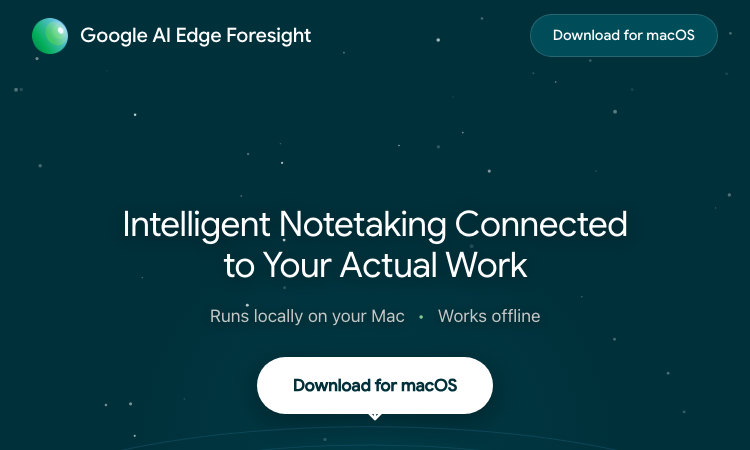
Google AI Edge Foresight
Google AI Edge Foresight — Start with the core task and use the guided workflow to evaluate fit.
Google AI Edge Foresight: a practical tool for your next project Google AI Edge Foresight is an experimental Mac meeting assistant designed to keep audio capture, note…
Explore App