Newest Lovable Apps
Discover beautiful apps crafted with vibe coding across different categories. Explore our curated collection of lovable applications.
Categories

UPLIFT Checker
UPLIFT Checker walks a CSJDM citizen through a 60-second form to confirm their beneficiary status.
UPLIFT Checker The user journey inside UPLIFT Checker is built for a specific moment: the citizen has heard about a program, suspects their name is on the list, and wants confirmation before traveling to a government office. UPLIFT Checker collapses that moment into a 60-second web interaction, with no friction and no gatekeeping. The page is intentionally calm — white background, blue accents, a single primary button — so the visitor's anxiety does not have anywhere to attach. From the first screen of UPLIFT Checker, the citizen sees exactly three things. First, a notice box clarifying that the form is only intended for residents of San Jose del Monte, Bulacan, and that the beneficiary data comes from DSWD Field Office III. Second, the section heading Check if you are included, with a helper line explaining the asterisk convention. Third, the form itself, with sensible placeholders drawn from real Filipino names: Last Name shows ex. DELA CRUZ, First Name shows ex. JUAN MIGUEL. Those placeholders inside UPLIFT Checker are not decorative — they model the correct capitalization and the kind of compound surnames a citizen is likely to have. As the citizen fills out the UPLIFT Checker form, the validation is unobtrusive but strict. Required fields are marked with an asterisk and cannot be submitted empty; optional fields (Middle Name, Extension Name) accept empty strings without complaint. The Barangay dropdown inside UPLIFT Checker lists every barangay in San Jose del Monte, so a citizen never has to type a place name by hand. The Birth Date input uses a native date picker, which handles leap years and edge cases more reliably than a free-text field would. When the citizen presses Search and check, UPLIFT Checker returns its answer on the same page. A match produces a positive confirmation; a miss produces a clear not found message, with the practical guidance that if a barangay is not listed, there is no granted beneficiary for that barangay. UPLIFT Checker never makes the citizen guess what the result means. For residents of San Jose del Monte, Bulacan, UPLIFT Checker is the calmest, fastest way to answer one specific question.
MiniMax H3 AI Video Generator
Create cinematic AI videos from text prompts and images with MiniMax H3.
MiniMax H3 Studio is an AI video generation workspace for creators who want to turn text prompts or image references into cinematic short videos. With MiniMax H3, users can create prompt-to-video and image-to-video clips with native audio sync, camera control, consistent character details, and high-quality 2K output. It is designed for social videos, product demos, ads, concept testing, cinematic scenes, and reusable creative workflows. Key features: Text-to-video generation from detailed scene prompts Image-to-video animation from reference images Native audio and video synchronization Camera movement and motion control 2K MP4 video output Reusable prompt cases and examples Credit-based plans for creators and teams MiniMax H3 Studio helps creators move from idea to video faster without complex editing tools.
Copero
Play seven free browser football games: build careers, guess legends, create dream teams, and take on daily challenges.
Free football games, built for the browser Copero is a collection of seven interactive football games for fans who enjoy career simulations, football trivia, squad building, and quick daily challenges. Everything runs directly in the browser—there is nothing to download and no account is required. What you can play King of Cups:Create a footballer, draft attributes inspired by legendary players, choose clubs and transfers, win trophies, and guide a complete career from debut to retirement. Quick Career: Simulate an entire football career in under two minutes. Daily Career: Play the same seeded career challenge as everyone else each day. Guess the Footballer: Identify a legendary player using clues about country, position, era, and attributes. Which Football Star Are You?:** Answer a short personality quiz and discover your football archetype. Build Your Best XI:Assemble a balanced team of legends within a limited budget, then simulate its season. Higher or Lower: Compare football legends across pace, shooting, passing, dribbling, defending, and physicality. Why players use Copero Free to play with no registration or paywall Works on mobile, tablet, and desktop Available in Spanish, English, and Italian Progress and personal bests stay locally in the browser Fast sessions with replayable choices and shareable result cards Original editorial guides and footballer profiles for players who want to go deeper Copero is designed as a lightweight, privacy-friendly football playground: open the site, choose a game, and start playing immediately.
Bento Page
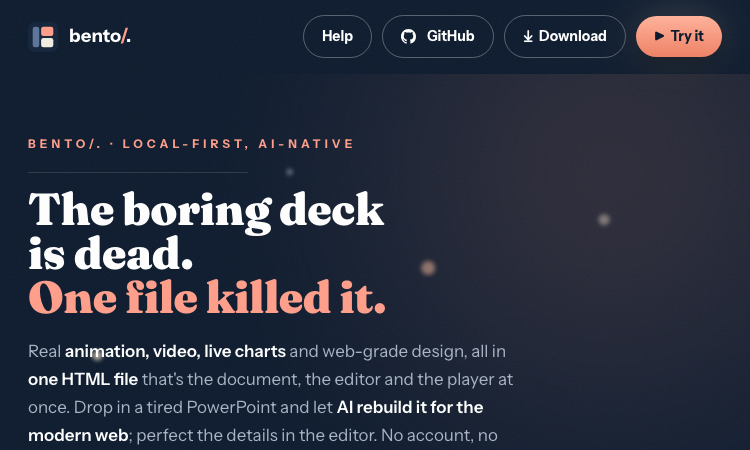
Bento Page uses a single-file model: every deck is one self-contained HTML with a JSON document inside.
Bento Page The defining architectural choice of Bento Page is its single-file model. Every Bento Page deck is one self-contained HTML file that simultaneously serves as the document format, the visual editor, the runtime player, and the collaboration surface. There is no separate .pptx, no companion .json, no cloud workspace. The same file you email to a colleague is the same file they open in their browser, the same file they edit, and the same file they present from. Inside that single Bento Page file lives a plain JSON document. The JSON describes every slide, every text block, every chart, every image, every embedded video, and every animation timeline. Because the format inside Bento Page is plain JSON, it is diffable in Git, editable in any text editor, parseable in any programming language, and convertible to other formats by simple scripts. The HTML wrapper around the JSON adds the rendering engine, the editor UI, the chart engine, and the collaboration runtime — all packed into roughly 640 KB. The single-file model of Bento Page has cascading consequences that users feel immediately. A deck can be archived by saving one file. A deck can be shared by emailing one attachment. A deck can be embedded in a blog post by uploading one HTML file. A deck can be reconstructed from a partial backup by recovering one file. There is no database to migrate, no schema to upgrade, no cloud service to deprecate. Bento Page treats the file as the canonical artifact, and that single decision is what makes the product feel so different from the rest of the presentation-software market. The future apps inside the Bento Page family — bento/spaces for notes, bento/dash for sheets and tables, bento/vault for secure storage — will all adopt the same single-file philosophy. For anyone who has ever lost a slide to a software migration or a vendor sunset, Bento Page is the radical bet that the file, not the platform, is the durable artifact.
Minimax H3
MiniMax H3: mix up to 9 images, 3 video clips, and 3 audio tracks in one prompt.
MiniMax H3 — One Model for Video, Sound, and Editing MiniMax H3 is a general-purpose multimodal AI video generator that treats text, images, video clips, and audio as a single creative context. Instead of running a prompt through one tool, cleaning it up in another, and adding sound in a third, you hand H3 everything at once and get back a finished scene with native stereo audio. What makes it different Most AI video tools do one trick well. MiniMax H3 does three: True multimodal input — mix up to 9 reference images, 3 video clips, and 3 audio tracks in a single request (12 files total). H3 reads the characters, motion, camera work, and style inside each one and merges them into a coherent take. Native audio on every output — ambience, sound effects, music, and synced dialogue arrive with the video, not after it. Supply a voice sample and H3 clones the tone for your characters. Instruction-based editing — swap a character, replace a background, relight a scene, or rewrite a line of dialogue in plain language. Everything you didn't mention stays pixel-stable. Core capabilities | Capability | Detail | |---|---| | Text to video | Prompts up to 7,000 characters | | Image to video | First/last frame control for precise start and end points | | Reference generation | Lock faces, copy choreography, match a style frame | | Output | Up to 1440p, 24 FPS, 5–15 second clips | | Aspect ratios | 21:9, 16:9, 4:3, 1:1, 3:4, 9:16 | | Audio | Native two-channel stereo on every generation | Where it performs best Game content. Game CG, first-person gameplay shots, character PVs, and animated UI demos. HUD elements, menus, and character designs stay consistent frame to frame. Stylized animation. Anime, claymation, pixel art, and 3D fantasy looks hold across cuts when you supply a style reference. Product and e-commerce. Flat product photos become listing videos with motion and sound. Packaging text, labels, and brand marks render accurately — the detail most generators get wrong. Cinematic work. Trailers, brand films, and short drama with real camera language: rack focus, handheld motion, hard cuts, match cuts, title cards. How it works Describe or upload. Type what you want, or attach reference images, clips, and audio. Generate. Pick an aspect ratio and hit generate. A video with synced sound arrives in minutes. Refine. Tell H3 what to change in a sentence. It edits while leaving the rest untouched. Download up to 1440p. There is no timeline, no keyframes, and no software to install. Beginners get watchable results on the first attempt; professionals get precise control through reference files and long structured prompts. Who uses it Content creators shipping daily vertical shorts. Marketers validating ten ad concepts in an afternoon instead of briefing an agency and waiting weeks. E-commerce sellers producing listing videos without booking a studio. Filmmakers previsualizing scenes before a day on set. Game teams building character PVs and UI walkthroughs. And people with no technical background at all, who just want the idea in their head to exist as a video. Start with one subject, one action, one camera move, then layer in references as you get comfortable. Try the MiniMax H3 AI video generator free — type your first prompt and watch it direct the shot for you.

Love Meter
Love Meter is a free, browser-native love-compatibility playground tuned for the first-time visitor.
Love Meter The first time a visitor lands on Love Meter, they are greeted by a soft pink gradient, a single declarative heading — What is your love score? — and a one-sentence promise that immediately lowers their guard: Choose a Love Meter by name or photo, play FLAMES, or ask Love Oracle. Love Meter understands that the audience arriving at a love test is rarely in a research mindset. They are curious, often nervous, sometimes testing it on a crush. The product is tuned for that emotional entry point. From that first screen, Love Meter offers exactly two text fields and one button. Your name, Their name, Reveal our score. There is no signup wall, no email capture before the result, no paywall between the user and their Love Meter score. A first-time visitor goes from landing page to shareable result card in under thirty seconds, which is exactly the latency profile that turns a casual visitor into a sharer. Once they have seen their own Love Meter result, the navigation above expands to show three sibling tools, and most users spend their next few minutes exploring those. The product journey inside Love Meter follows a calm three-act structure. Act one is the free test — enter two names, see the score, send the share card. Act two is the sub-tools tour — Love Meter by Photo, FLAMES Calculator, Love Oracle — each delivering its own free result. Act three, which most casual visitors never reach, is the optional paid AI reading: a 100-credit unlock that adds strengths, challenges, communication ideas, and a personalized story to the existing result. Love Meter never forces a visitor through act three, and the brand voice gently acknowledges that act one is the real product. For the couples and friend groups who return to Love Meter after the first visit, the deterministic engine is what keeps the experience trustworthy. The same two names always produce the same score, the same Chemistry number, the same Couple Type. Love Meter does not feel like a slot machine; it feels like a small, repeatable ritual. For anyone planning an ice-breaker, a games night, or a romantic gesture, Love Meter deserves the first bookmark of the evening.

Access TikTok media cleanly without tra
View and download TikTok stories and videos anonymously.
When you are working on a desktop and need to quickly check a public reference link or video on TikTok, getting hit with a heavy full-screen login wall is a major productivity killer. SneakStory was built to solve this exact friction point. It is a streamlined web platform that lets developers, researchers, and casual users view public TikTok stories and download watermark-free media instantly. No sign-ups, no tracking, and no mobile app required—just clean, open-web browsing.

Natiga Thanwya
Natiga Thanwya is an Arabic-first Egyptian high school results portal for the calm 2026 results day.
Natiga Thanwya Every July, millions of Egyptian households gather around a phone screen waiting for a single moment: the appearance of the Thanawiyya Amma results. Natiga Thanwya exists for that moment. It is a focused, Arabic-first results portal that replaces the anxiety of opening ministry websites with a calm, structured lookup experience designed for students, parents, and the extended family WhatsApp group. The emotional center of Natiga Thanwya is the result card. When a student enters their seven-digit seat number — or searches by name as a fallback when the seat number is misplaced — Natiga Thanwya returns a single, dignified screen that shows the total score out of 320, the percentage, the grade rating, and the national ranking. Nothing flickers. Nothing autoplays. The card is sized to be readable on a small phone screen, and its typography is tuned for high-contrast reading at arm's length. That is the entire job of Natiga Thanwya, and it does the job with care. What elevates Natiga Thanwya above generic government portals is the aftercare. Once a student has viewed their result, Natiga Thanwya surfaces three follow-up actions that respect the gravity of the moment: download an honor certificate styled for sharing, print the result for school records, or start a new search. Each of those flows keeps the user inside Natiga Thanwya, so the student never has to navigate a maze of external links while their family is waiting for the screenshot. For parents and older relatives who may not be as confident with online forms, Natiga Thanwya offers the name-search path as a graceful fallback. A mother who only knows her child's full name in Arabic script can still resolve the result on Natiga Thanwya without translating seat numbers or memorising digits. That accessibility choice is what makes Natiga Thanwya feel like a product built by someone who has actually lived through a results day, not just designed one. On the next results morning, Natiga Thanwya deserves to be the first tab open.

Image to Video AI turns photos into HD videos online. Upload an image, describe the motion, and create cinematic clips for social media, ads, and products.
Ai News Generator
Turn Any Story into a Broadcast-Ready News Video.
AI News Generator helps you turn any topic, article, or script into a professional news-style video in minutes. Create realistic AI anchors, broadcast-ready scenes, captions, voiceovers, and breaking-news visuals without cameras, actors, or complex editing. Perfect for social media, marketing, education, commentary, and rapid news content production.
Guildrun - Heroes, Builds, Wiki and Stra
Plan Guildrun runs with the local Demo 0.5.1 archive: compare heroes, inspect item and relic effects, read stage formati
Guildrun - Heroes, Builds, Wiki and Strategy Guide Plan Guildrun runs with the local Demo 0.5.1 archive: compare heroes, inspect item and relic effects, read stage formations, and turn each loss into a clearer next decision. This Guildrun guide and wiki covers the Demo 0.5.1 dataset. It helps players move from the opening draft to a stable formation by combining practical handbooks with searchable records for heroes, items, relics, enemies, stages, and events. Strategy pages emphasize decision frameworks—role coverage, targeting, economy, and rank order—rather than fixed tier lists. Database pages keep exact values, effects, and route connections so you can compare a shop offer or failed fight with the current Demo record. Start with the beginner guide, then the strategy guide, or open the player handbook. Compare the full hero roster, then use the Wiki and World directories when you need a specific record. Use site search to jump straight to a name, or visit the release status page for current availability and development plans.

Destininja
Destininja — a French ninja career-sim: build your shinobi, follow your nindo, chase the Kage dream.
Destininja Some games chase spectacle. Destininja chases stillness. It is a browser-based French-language narrative game about what it means to live a ninja career — not the cinematic version, but the slow accumulation of training, missions, rank promotions, and quiet reputation that turns a shinobi into someone the village eventually recognizes. Destininja opens with a single sentence that sets the tone for everything that follows: "Vivez votre aventure Ninja et suivez votre nindo!" — live your ninja adventure and follow your nindo. Your nindo is your personal creed, and Destininja treats it as the spine of the entire playthrough. There are no flashy tutorials. The product drops you at a character creation screen, asks for a name, and trusts you to discover the rules through play. The journey inside Destininja is structured as a series of year-cards, each representing a chapter of your shinobi's life. Within a Destininja chapter you will find four kinds of moments: training sessions, missions, exams, and combat encounters. Every choice you make pushes one of five stats — Technique, Strength, Speed, Chakra, or Intelligence — and shapes your grade for that year. A perfect Destininja year earns an S; a turbulent year earns a C or D. Grades stack, and over time the stack becomes your shinobi's legacy. What makes Destininja emotionally resonant is its attention to consequence. A Destininja player who leans too hard into combat will ace fights but stumble on exams. One who ignores missions will starve their ryo balance and never unlock the Boutique gear that defines late-game titles. Destininja rewards balance, patience, and the willingness to live with imperfect years. The Historique panel lets you revisit past Destininja runs as trophies of identity, not just statistics. For readers who fell in love with the quieter side of ninja storytelling — the philosophy, the village politics, the slow walk from academy student to respected Kage — Destininja is the rare web game that respects their attention. Open Destininja, commit to a nindo, and let the years compound.