Newest Lovable Apps
Discover beautiful apps crafted with vibe coding across different categories. Explore our curated collection of lovable applications.
Categories
imagetostl
AI-powered Image to STL converter that turns JPG, PNG, and WEBP images into 3D printable STL models with online 3D previ
ImageToSTL.pro is an AI-powered online Image to STL converter that transforms 2D images into 3D STL models for 3D printing, prototyping, gifts, product ideas, and maker projects. Simply upload a JPG, PNG, JPEG, or WEBP image, choose a generation mode, and let AI generate the 3D geometry. You can inspect and rotate the model directly in the browser before downloading the STL file. Key Features AI Image to STL Conversion – Turn ordinary images into 3D STL models automatically. Multiple Generation Modes – Choose Fast, Standard, or Advanced depending on the quality and detail you need. Interactive 3D Preview – Rotate and inspect the generated model before downloading. 3D Printing Ready Workflow – Download STL files and open them in your preferred slicer for scaling, orientation, and support configuration. Multiple Image Formats – Supports JPG, JPEG, PNG, and WEBP. Text to 3D & Multi-Image Workflows – Generate models from text prompts or multiple reference views. No Traditional 3D Modeling Required – Quickly create an STL starting point without manually modeling from scratch. ImageToSTL.pro is useful for makers, 3D printing enthusiasts, designers, Etsy sellers, educators, hobbyists, and anyone who wants to quickly turn an image or idea into a printable 3D model. Website: https://imagetostl.pro
upscale image
upscale image online free
flow ai
Flow AI Video Generator Online AI Video Models - Veo3 & Veo3.1 & Veo 3.2
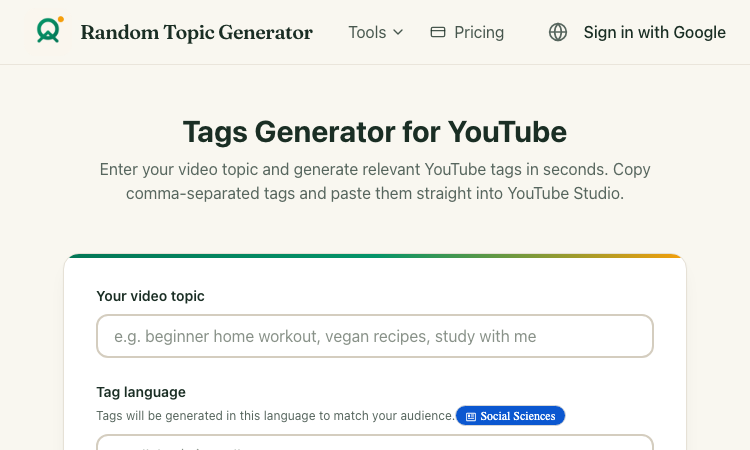
Tags Generator For Youtube
Tags Generator For Youtube — enter your video topic and get 10, 20, or 30 comma-separated YouTube tags.
Tags Generator For Youtube Tags Generator For Youtube is a free tool that generates relevant YouTube tags from your video topic in seconds. If you have ever published a video and struggled with the Tags field in YouTube Studio, Tags Generator For Youtube is exactly the tool you have been looking for. Here is how to use it. Step 1: Sign in with Google. Tags Generator For Youtube is free and unlimited for logged-in users. The Google sign-in keeps the service free and prevents abuse, so real creators can generate as many tag sets as they need — no credits, no limits, no paywalls. Step 2: Enter your video topic. Type your topic in plain words. It can be as simple as "sourdough bread recipe" or as specific as "best budget laptops 2026". Tags Generator For Youtube understands the topic and builds a set of relevant tags around it. Step 3: Choose your tag count. Tags Generator For Youtube lets you pick 10, 20, or 30 tags per generation. More tags give you broader coverage; fewer tags keep the list focused. Either way, the output is comma-separated — the exact format YouTube Studio's Tags box accepts. Step 4: Copy and paste. One click copies the entire tag list. Open your video in YouTube Studio, paste the tags into the Tags field, and you are done. The whole workflow takes under a minute, which is the whole point of Tags Generator For Youtube. Step 5: Pick your language. Tags Generator For Youtube supports multiple languages, so you can generate tags in the language of your audience. If you are a creator targeting viewers in another country, this is a feature you will use on every upload. Why do tags matter? Tags Generator For Youtube explains it well: tags are one of several signals YouTube uses to understand your video. They help with misspellings and topical grouping, and they work best when combined with a clear title, description, and thumbnail. The tags from Tags Generator For Youtube are designed to cover the different ways viewers search, which gives your video more chances to be discovered. Tags Generator For Youtube is free, fast, and built for the real publishing workflow. Sign in, enter your topic, copy your tags, and get back to making videos — that is the Tags Generator For Youtube promise. It is the kind of tool that saves you time on every single upload.

Attractiveness Test
AI-powered photo feedback for attractiveness, facial features, and profile pictures
AttractivenessTestLab AttractivenessTestLab is an AI-powered photo analysis tool that gives users instant feedback on how a portrait or profile photo may be perceived. Upload a photo and receive an easy-to-understand analysis covering facial appearance, visible proportions, symmetry, photo quality, and overall presentation. Main Features AI Attractiveness Test — Get an AI-generated attractiveness score and detailed photo feedback. Face Rating — Analyze facial proportions, symmetry, and other visible characteristics. Beauty Test — Explore how different facial and photographic factors influence the overall impression of a portrait. Face Shape Detector — Identify your approximate face shape from a photo. Rate My Photo — Evaluate whether a particular photo works well as a profile picture. Instant Results — Upload a photo and receive feedback within seconds. Easy to Use — No complicated setup or professional photography knowledge required. Why Use It? Two photos of the same person can look very different because of lighting, camera angle, expression, framing, and image quality. AttractivenessTestLab is designed to make those differences easier to understand. Instead of treating a score as an absolute judgment, users can compare different photos and discover which lighting, angles, expressions, and compositions work better for them. It can be useful when choosing photos for social profiles, dating profiles, professional accounts, or simply experimenting with portrait photography. Try it at AttractivenessTestLab.
ArchOne AI
All-in-one AI spatial design visualization platform for interior, exterior and landscape design.
What Is ArchOne AI? ArchOne AI is an all-in-one AI spatial design visualization platform for early-stage workflows across architecture, interiors, exteriors, and landscapes. It helps users turn real visual inputs into clearer design directions. You can upload a room photo, house exterior image, outdoor site photo, sketch, render, or reference image, then generate AI-powered concept options for different types of spaces. Key Features ArchOne AI supports several design visualization workflows in one place. Users can generate interior design concepts from room photos, sketches, renders, or reference images. They can explore room styles, furniture direction, lighting mood, color palettes, and material combinations. For home exterior projects, ArchOne AI helps users study facade updates, exterior colors, siding or cladding ideas, entry upgrades, roof and trim directions, and curb appeal concepts. For landscape and outdoor spaces, users can explore planting ideas, hardscape concepts, garden layouts, patio directions, privacy treatments, outdoor seating zones, lighting mood, and overall site atmosphere. Who Is It For? ArchOne AI is built for architects, architectural designers, interior designers, landscape designers, small design studios, design consultants, renovation teams, students, and property owners. Architects and design studios can use it to explore early visual options before detailed drawings or render production. Interior designers can test room styles, materials, lighting moods, and furniture directions before presenting ideas to a client. Landscape designers can turn site photos or outdoor sketches into quick planting, hardscape, and outdoor living concepts. Renovation teams and property owners can use it to communicate design ideas more clearly before speaking with designers, builders, or contractors. Students can use it to explore spatial ideas, study design directions, and improve the clarity of early concept presentations. What Can You Do With ArchOne AI? For interiors, you can test styles such as modern, minimalist, Scandinavian, Japandi, farmhouse, luxury, or warm neutral. You can compare material palettes, lighting moods, furniture density, and room atmosphere. For exteriors, you can explore facade concepts, paint color options, siding ideas, front entry updates, trim changes, and curb appeal improvements. For landscapes, you can generate ideas for gardens, yards, patios, pool areas, front yards, backyards, planting beds, pathways, outdoor seating, lighting, and hardscape layouts. How Does ArchOne AI Work? Start by uploading a visual input. This can be a room photo, house exterior image, outdoor site photo, sketch, render, screenshot, or reference image. choose the design workflow that matches your project, such as interior design, home exterior design, landscape design, yard design, garden design, patio design, or floor plan concept generation. Select a design direction and add project notes. You can describe the style, materials, mood, space type, features to keep, and ideas you want to explore. ArchOne AI then generates visual concept options based on your input. You can compare the results, refine your notes, generate more variations, and download images depending on your plan. Pricing ArchOne AI offers a free plan and paid options based on design credits. The Free plan includes 5 credits and is useful for testing the workflow. It supports interior, exterior, and landscape design tools, preview-quality exports, and watermarked images.

the calcolo iva
Free Italian VAT calculator and tax guides, built for freelancers and businesses.
TheCalcoloIVA.com is a free online resource built for anyone dealing with Italian VAT (IVA), from freelancers opening their first partita IVA to established businesses managing complex tax obligations. The site combines practical calculator tools (VAT calculation, invoice breakdowns, IMU, TFR, and more) with over 700 in-depth articles covering VAT rates by product category, invoicing rules, electronic invoicing codes, tax regimes (regime forfettario and beyond), international VAT for cross-border sellers, and up-to-date coverage of Italy's frequently changing tax decrees. Every guide is written in plain, accessible language and grounded in official sources, including the Agenzia delle Entrate, Normattiva, INPS, and the Gazzetta Ufficiale, so readers get accurate, current answers instead of generic tax advice. Whether you're calculating what you owe, checking a VAT rate, or trying to make sense of a new fiscal decree, TheCalcoloIVA.com is built to give you a clear answer fast.
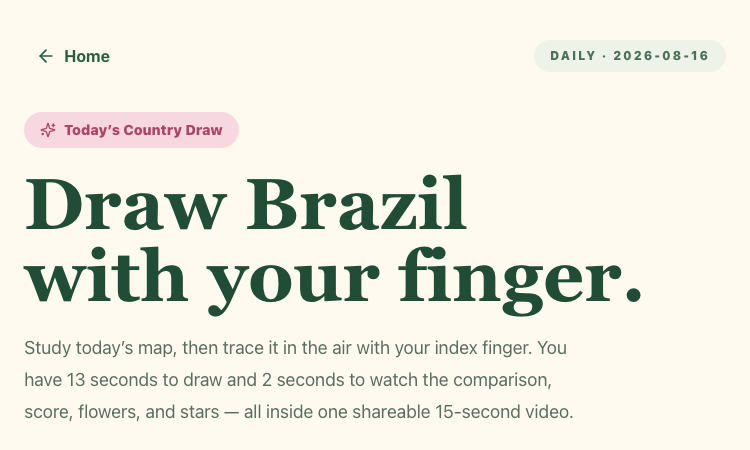
Country Draw Vercel App
Country Draw Vercel App — study a country map, trace it in the air, and share your 15-second score video.
Country Draw Vercel App Country Draw Vercel App is a daily challenge where you draw a country's map in the air with your finger — and your camera scores you. It is part geography quiz, part drawing game, and part social video maker, all wrapped in a 15-second format that is impossible not to share — the signature format of Country Draw Vercel App. Here is how to play. Step 1: Study the map. Country Draw Vercel App shows you today's country — its outline, its name, and a hint about where it sits on the globe. Take a few seconds to memorize the shape. The challenge changes every day, so today might be Brazil and tomorrow something you have never heard of — that is the daily hook of Country Draw Vercel App. Step 2: Draw in the air. Press the camera button and hold your index finger up. Country Draw Vercel App tracks your fingertip in real time using hand tracking, and you have 13 seconds to trace the country's shape in the air. You do not touch the screen — you draw in space, like a conductor tracing a shape, and Country Draw Vercel App records every move. The game follows your finger and records your path. Step 3: Compare. After your 13 seconds, Country Draw Vercel App shows a 2-second side-by-side comparison of your drawing against the real map. This is the moment of truth — and usually the moment of laughter. Step 4: Share. The whole attempt is rendered into a single 15-second video: your drawing, the comparison, your score, flowers, and stars — the moment Country Draw Vercel App was made for. Country Draw Vercel App gives you a video ready to share with friends, and because everyone plays the same daily country, comparing scores is half the fun. A few things make Country Draw Vercel App stand out. It is private: hand tracking and scoring stay on your device, and the page promises no camera upload. It is playful: optional camera masks — fox, cat, frog, panda, clown — add personality to your video. It is free: no account, no paywall, no install. And it is educational without feeling like it: after a few weeks of daily challenges, you will know country shapes you never thought about before — a side effect Country Draw Vercel App is proud of. Country Draw Vercel App is the perfect 30-second break. Open the page, study today's map, and draw it in the air. Your score video is waiting.

scientific figure
Scientific Figure — Free AI Scientific Figure Generator
Scientific Figure is a Free AI-powered scientific figure generator built for researchers. It creates editable figures from text, sketches, reference images, or the paper itself, and exports them as layered SVG, editable PPTX, or high-resolution PNG. Because every element stays editable, a reviewer comment costs a two-minute edit instead of a full redraw. Text-to-Figure Converts a description of a mechanism, workflow, or experiment into a structured draft that can be refined to publication quality. Sketch-to-Figure Turns a hand-drawn lab-notebook sketch into a polished figure while preserving its scientific logic, with everything still editable afterwards. Reference-to-Figure Generates an original figure in the style of a reference image, applying its composition, color palette, and information density to your own content. Selective Editing Select a single region and regenerate just that part: fix a label, redirect an arrow, recolor one panel, without starting over. Editable Export Exports layered SVG, editable PPTX, and PNG at 600+ DPI (up to 8K, no watermarks), so files still open properly in Illustrator or PowerPoint months later. Specialized Tools graphical abstract maker sized for journal submission portals scientific poster maker with A0 and A1 layouts scientific illustration generator for diagrams and schematics Multiple Image Models Nano Banana, Nano Banana 2, Nano Banana Pro, GPT Image 1.5, and GPT Image 2, across six visual styles: scientific schematic, line art, 3D render, editorial, sketch, and watercolor. Three-Step Workflow Define the scientific narrative, generate a structured draft, then review, refine, and exåport for manuscripts, posters, or presentations. Authors keep full publication and commercial rights to everything they generate, and private uploads are encrypted in transit and at rest and are never used to train models - which matters when the figure describes unpublished data. For researchers who need to communicate their ideas visually, Scientific Figure turns a rough idea into an editable, publication-ready figure. New accounts start with 50 free credits and no credit card; paid plans begin at $20 per month.
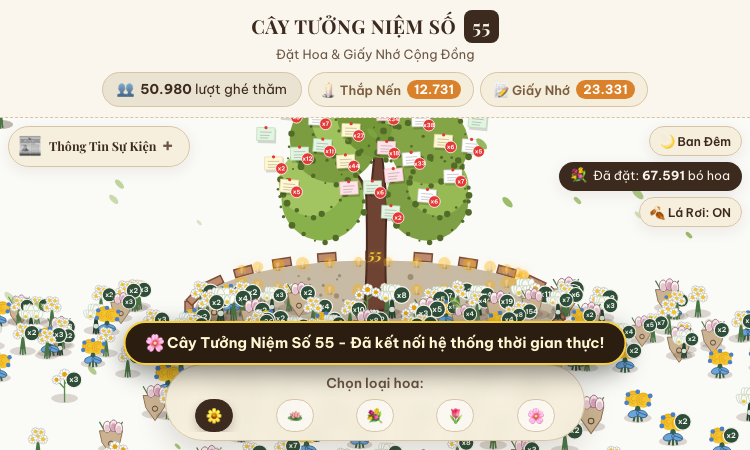
caybmw55
caybmw55 - Place a virtual flower, light a peace candle, and stick a memory note on Tree 55.
caybmw55 Using caybmw55 takes only a moment, but the gesture stays. The page is an online memorial tree for the victims of the 2025 Hanoi BMW crash, and everything on it is designed to make paying respects easy and meaningful. When the page loads, a vintage kraft-paper scene appears with a tree at the center, a soft falling-leaves animation, and live counters showing the community's shared acts of remembrance. Placing a flower on caybmw55 is as simple as clicking the ground. A popup lets you choose from six flower types — wild daisies, lotus, yellow and green roses, kraft tulips, daisy chrysanthemums, and a night-bloom option — and you can add a short message that gets pasted onto the tree trunk like a sticky note. A simple math check (5 + 3 = ?) keeps the tree from being flooded, and each person can place one bouquet, which keeps the gesture honest and personal. Beyond flowers, caybmw55 offers two more ways to remember: light a peace candle, or write a memory note and stick it on the tree. The community has already lit more than 13,000 candles and left more than 23,000 notes, and every action syncs instantly through Firebase Realtime Database — place a flower and the counter updates for everyone, right now. The visitor counter shows nearly 51,000 visits, a quiet measure of how many people have come to remember. The page also includes links to news coverage of the event — Luật Khoa, Dân Trí, and the Wikipedia article on the 2025 Hanoi crash — so visitors can understand the context while they pay their respects. For anyone who wants to remember the victims of the Hanoi accident, caybmw55 is a gentle, shared place to do it.

Imagine Image
Imagine Image: the free AI generator people find when searching Grok Imagine Image, now running on Imagine Image 2.0 — n
If you searched Grok Imagine Image, here's what you found: Imagine Image, a free AI generator running on Imagine Image 2.0. What it does Text-to-image — describe a scene, get a render Image-to-image — restyle a photo while keeping its framing Image-to-video — animate a still into a short clip Models available Grok Imagine Image generation via xAI's Grok Imagine, plus GPT Image 2, Seedream 5 Lite, and Nano Banana 2 — all in one page, switchable anytime. Why people use Imagine Image Full resolution on the free tier No watermark Free for commercial use Imagine Image 2.0 is live now at imagineimage.io.
Undertale Soul Quiz
Undertale Soul Quiz - Answer 14 scenario questions to get a free downloadable soul trait card.
Undertale Soul Quiz Taking the Undertale Soul Quiz takes about five minutes and requires no sign-up. When you press START THE QUIZ, you are presented with fourteen scenario-based questions, each with four choices, covering situations around conflict, fear, fairness, boundaries, setbacks, and long-term effort. The Undertale Soul Quiz tells you to choose what you would most likely do — not the answer that sounds most impressive — because the quiz is designed around behavior and tradeoffs, not ideal selves. The questions feel genuinely thought through. A listening response might support Patience and Kindness; a direct accountability response might support Justice and Bravery. Every choice in the Undertale Soul Quiz contributes three points to its strongest matching trait and one point to a supporting trait, which keeps the scoring honest and makes mixed results the norm rather than an error. There is no favorite-color question and no way to game a single obvious virtue. When you finish, the Undertale Soul Quiz compares the seven trait totals with deterministic tie-breaking and produces your result card: the leading Soul, its strengths, its blind spots, a challenge style, and your second-closest Soul. The card is downloadable, so you can save it or share it with friends who took the same quiz. A full score line and calculation details are included, because the scoring is meant to be inspectable. For a deeper read, the optional private AI analysis on the Undertale Soul Quiz examines all fourteen of your answers, explains why the two leading traits fit your pattern, and ends with practical reflection prompts. It never receives your result image and cannot infer hidden biography from a few choices. You can also retake the Undertale Soul Quiz anytime — just remember that chasing a preferred color defeats the purpose. Answer honestly, get your card, and see which Soul describes you today.